What We Saw at China’s Bakery Machinery & Food Equipment Fair
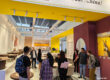
Last week, we visited a bakery machinery and hotel equipment exhibition in Guangzhou.
The exhibition gathered many suppliers from different parts of China, showcasing a wide range of commercial baking and food processing equipment.
We saw everything from industrial dough mixers and mooncake production lines to filling machines, packaging systems, bakery ovens, and automated food processing equipment.
For buyers sourcing bakery or food production equipment in China, exhibitions like this are a good way to understand the market and compare different suppliers in one place.
Exhibition Overview
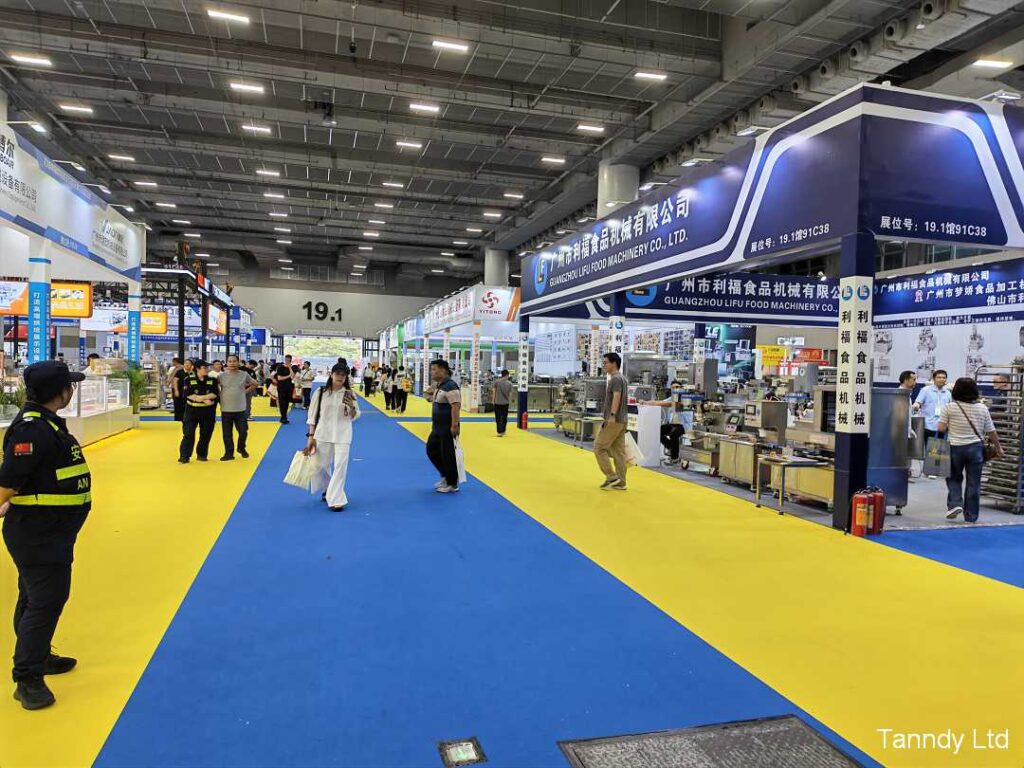
The exhibition was held at the Canton Fair Complex in Guangzhou and was part of the larger HOTELEX exhibition series.
HOTELEX is a major trade exhibition covering hotel supplies, commercial kitchen equipment, food products, restaurant equipment, and related hospitality industries across China.
Most of the bakery machinery exhibition was located in Area D, mainly across Halls 18 and 19, which were dedicated to bakery machinery, food processing systems, packaging equipment, and hotel-related commercial equipment.
Besides the machinery halls, Hall 20 also featured a local-focused baking ingredients exhibition, where many local bakery business owners and visitors were exploring different ingredients, raw materials, and food products.
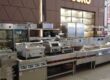
Many suppliers brought full-size production machines directly onto the exhibition floor for live demonstrations, allowing visitors to observe how the equipment actually operates in real production scenarios.
Above are some of the exhibitors participating in this year’s bakery machinery exhibition.
Most of the equipment suppliers were based in Guangzhou, while many others came from nearby Foshan, which is also an important manufacturing area for commercial equipment and food machinery.
We also noticed suppliers from other parts of China, including Hebei, Jiangsu, Xiamen, and several other industrial regions.
One possible reason is that many of the machines on display were quite large and heavy, so it is naturally more convenient for Guangzhou-based suppliers to transport and showcase their equipment at a local exhibition.
Walking through the halls, we could see a wide range of manufacturers — from smaller specialized equipment makers to companies presenting complete industrial production systems for bakery and food processing factories.
Section 1 — Industrial Mixing Equipment
These two machines were some of the largest automated cooking kettles we saw at the exhibition.
The scale was honestly quite impressive in person. Standing next to them gave a strong visual impact because the machines were much larger than they appear in photos.
Most of the structure consists of a massive stainless steel cooking bowl combined with a rotating mixing core inside, which continuously stirs the ingredients during the cooking process.
Some models were designed as 60-liter cooking kettles, while others were larger 80-liter versions. We also noticed that some machines used single-direction mixing systems, while others supported dual-direction operation, suggesting that different models are designed for different cooking and food processing requirements.
Looking closer inside the machines, the interiors were highly polished and very smooth.
Some of the mixing systems looked surprisingly complex, with multiple blades, paddles, and stirring arms installed around the rotating core.
It seems that these different stirring structures are designed to improve heat distribution and help ingredients cook more evenly during large-scale food production.
These are commercial food mixers, sometimes also called planetary mixers or chef mixers.
They can be used for mixing fillings, processing ingredients, or kneading dough for bakery production.
Most of the models on display were significantly larger than typical household mixers, clearly designed for commercial kitchens, bakeries, and food factories.
Based on the specification labels shown on the machines, many of the mixers were divided into three operating speeds:
- High speed — around 380 RPM, mainly used for egg mixtures, cream, and lighter ingredients
- Medium speed — around 160 RPM, suitable for fillings, minced meat, and thicker mixtures
- Low speed — around 100 RPM, mainly used for dough kneading
Walking through the exhibition, we could see that many suppliers offered mixers in different capacities and configurations depending on the production scale and food category.
Section 2 — Mooncake & Bun Production Machines
Several suppliers specialized in automated mooncake and bun production equipment.
Some machines could automatically fill, shape, and portion products with different fillings, helping factories improve production consistency and efficiency.
This type of equipment is commonly used for mooncakes, buns, pastries, and other filled bakery products.
We saw many exhibitors showcasing fully automated mooncake production lines at the exhibition.
These machines can be used not only for mooncakes, but also for different types of filled pastries and traditional bakery products.
Many suppliers displayed complete production systems that could handle the entire process — from dough preparation and filling mixing to dough wrapping, molding, stamping, and baking.
Most of the suppliers also offered different molds and shaping tools, allowing factories to produce various patterns and product styles depending on the season or product category.
Looking closely at the finished products on display, the mooncakes actually looked quite neat and visually consistent, showing how these automated systems help improve large-scale production quality.
This supplier specialized in fully automated bun production lines.
The buns produced by the machine were very uniform in size and shape, and the finished appearance looked surprisingly clean and consistent.
The production line itself was fairly long and integrated multiple stages into one system, including dough feeding, filling injection, wrapping, and final forming.
At the end of the line, the buns were automatically arranged in batches, ready for steaming, packaging, or further processing.
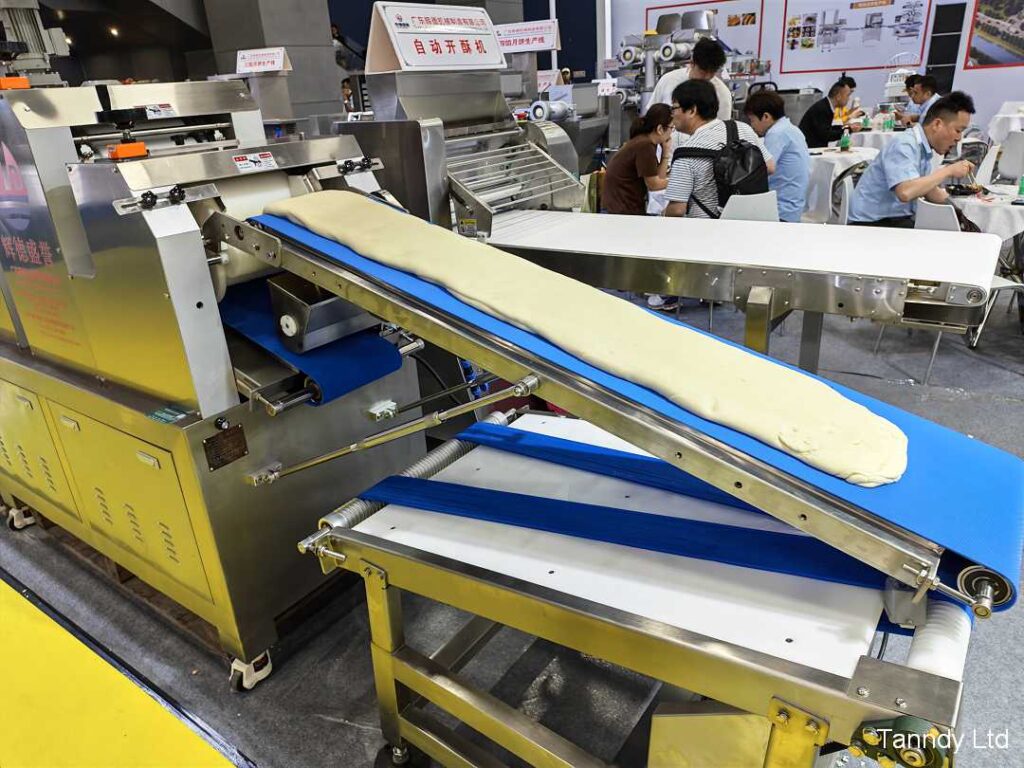
This machine was designed for automated noodle production.
The system can quickly produce noodles in large quantities through a continuous production process.
From dough mixing and kneading to rolling, flattening, and noodle cutting, the entire workflow is integrated into a single production line.
Compared with smaller commercial kitchen equipment, these systems are clearly designed for large-scale food factories and industrial food production environments.
Section 3 — Bakery Production Lines
Some exhibitors presented complete bakery production lines, including conveyor systems, shaping machines, baking systems, and packaging equipment.
These setups are usually designed for medium to large-scale food factories.
These were large commercial baking ovens designed for bread, pastries, cakes, and other bakery products.
Most of the machines were quite large and could handle a high baking capacity in a single batch, making them suitable for bakeries, central kitchens, and commercial food production environments.
We have seen similar-sized ovens used in some professional bakeries before, but this supplier brought many different models to the exhibition floor for demonstration.
The supplier was from Dongguan, and it seemed that they specialize specifically in bakery equipment and industrial baking systems.
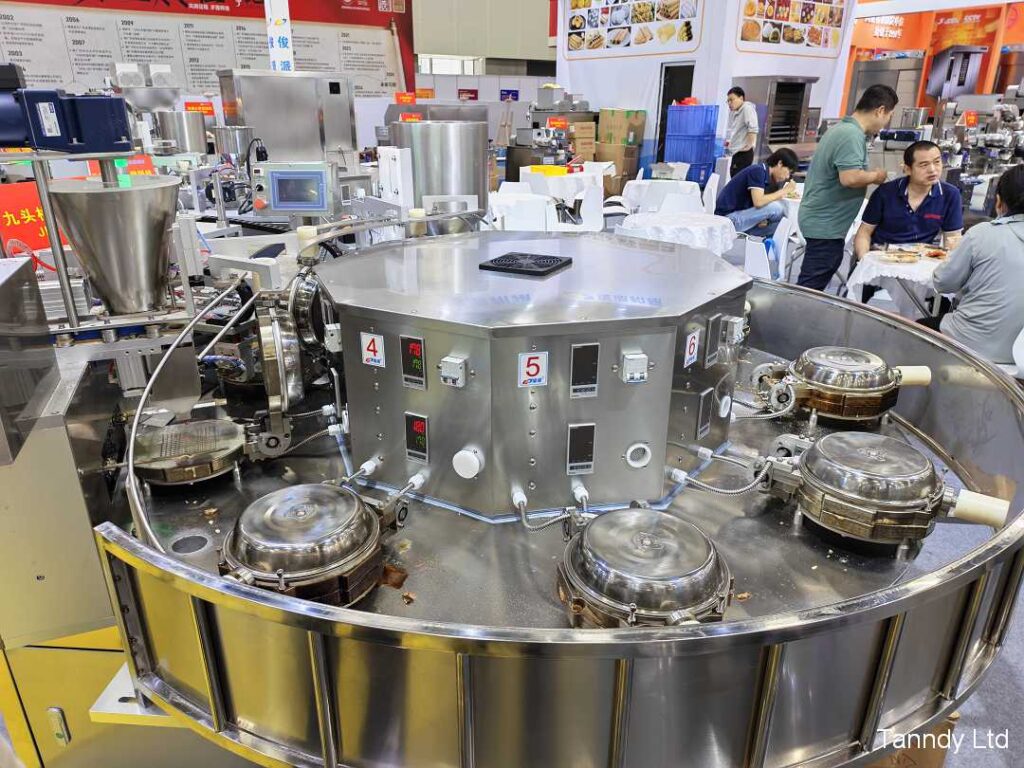
This machine was a multi-head cake baking system.
One machine could operate with around 8 to 10 baking heads at the same time, allowing multiple products to be baked simultaneously.
Because all the baking stations work together in parallel, the production efficiency is quite high compared to smaller standalone baking equipment.
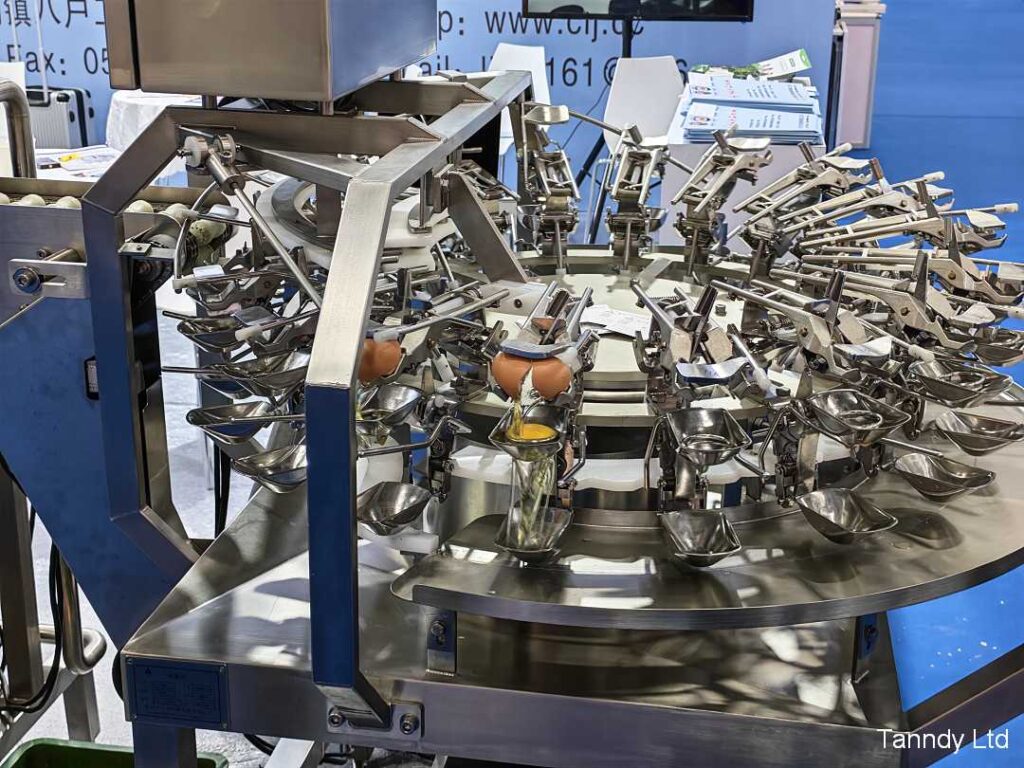
This was an automated egg cracking machine.
The machine uses many claw-like gripping heads, with each head holding and cracking an egg automatically.
After cracking, the egg liquid flows through a guided channel into a shared collection area.
One interesting detail we noticed was that the egg-cracking heads continuously rotate while operating, which helps improve processing speed and overall efficiency.
Machines like this are clearly designed for large-scale bakery production, especially for factories producing cakes and pastries in high volumes.
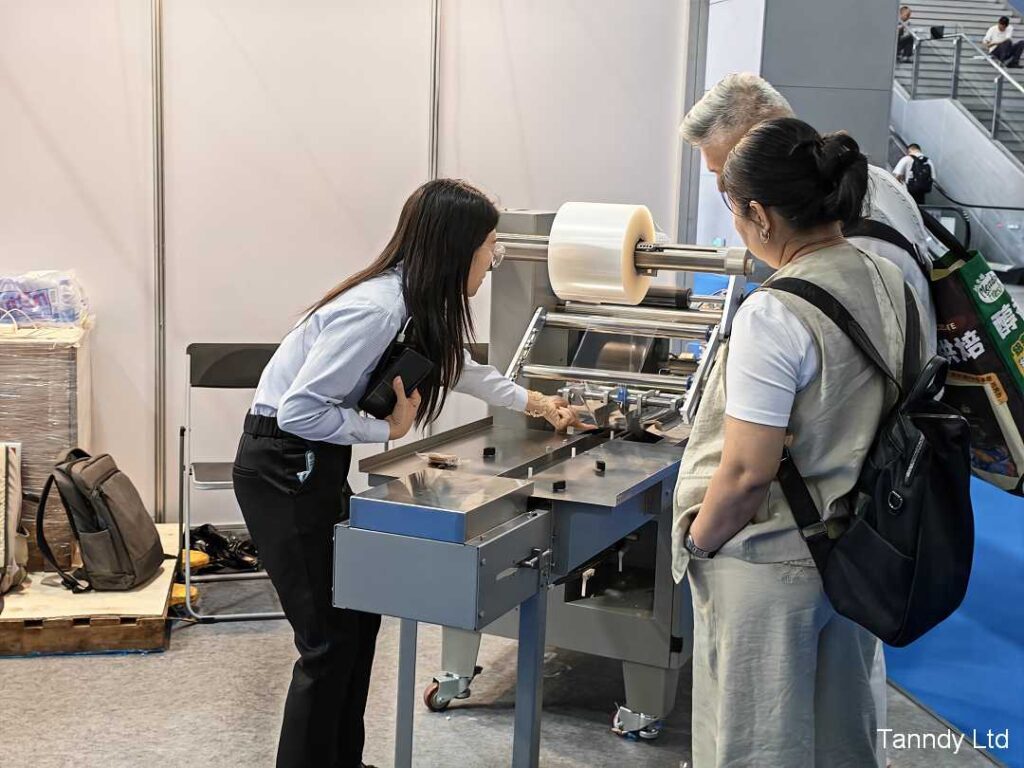
This was a fully automated packaging machine.
The system can automatically package individual products such as biscuits, pastries, or filled bakery items one by one through a continuous conveyor process.
At exhibitions like this, we often noticed that many suppliers focus not only on food production itself, but also on the later stages of packaging and production automation.
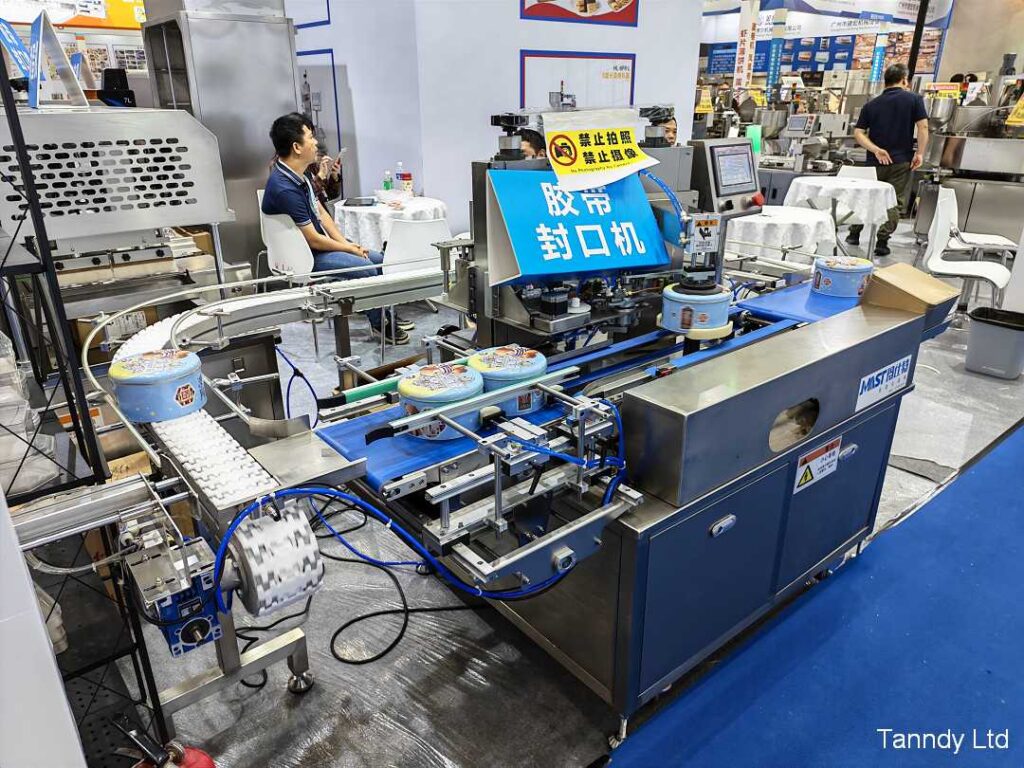
This machine was an automatic tape sealing machine used for packaging and carton sealing.
Compared with the larger bakery production systems nearby, the machine itself looked relatively simple, but equipment like this is still an important part of the overall production and shipping workflow for food factories and commercial bakeries.
Section 4 — Stainless Steel Commercial Equipment
Some suppliers at the exhibition focused specifically on large commercial stainless steel containers, buckets, and mixing bowls.
Most of these products were much larger than normal household kitchen equipment and were clearly designed for hotels, restaurants, central kitchens, and commercial food preparation environments where large quantities of ingredients need to be processed or stored.
This supplier was from Jiangmen, a city that is well known in China for stainless steel manufacturing and related industrial products.
Walking around their booth, we saw many different sizes and configurations of stainless steel equipment, ranging from deep storage containers to oversized mixing bowls and commercial kitchen basins.
The large stainless steel bowl in the final image was especially impressive in person. It was enormous — honestly large enough to fit two adults inside. Standing next to it really gave a sense of the industrial scale of some of the equipment displayed at the exhibition.
What Makes These Exhibitions Useful?
Compared with the Canton Fair, we did not see many overseas buyers at this exhibition. Most of the visitors appeared to be local buyers and industry professionals from China.
One possible reason is that many international buyers tend to visit during the Canton Fair period, while this exhibition is smaller and more specialized.
However, in terms of professional focus, this bakery machinery exhibition was actually much more concentrated. Walking through the halls, almost everything was related to bakery equipment, food processing systems, and production machinery.
For overseas buyers, exhibitions like this can still be very valuable.
Instead of only looking at catalogs or online photos, visitors can directly inspect the machines in person, evaluate the build quality, understand the functions more clearly, and see whether the equipment matches their production requirements.
Many suppliers were also running live demonstrations, allowing visitors to observe the final food products and production results directly on-site.
Another advantage is that buyers can communicate face-to-face with factories about customization, machine configurations, production capacity, and specific operational requirements.
Because many suppliers are gathered in the same exhibition halls, it also becomes much easier to compare different manufacturers side by side — including their product quality, factory scale, technical capability, and even their communication and cooperation attitude.
Hotel Supplies Markets in Guangzhou
If you missed the exhibition, or if you feel that the exhibition alone is not enough, Guangzhou also has several large hotel equipment and commercial kitchen supply markets worth visiting.
Two of the best-known markets are:
These markets contain a large number of suppliers selling commercial kitchen equipment, bakery tools, hotel supplies, restaurant equipment, stainless steel products, and many other related products.
Compared with trade exhibitions, the markets are open year-round and usually offer a very wide selection of products and equipment in one area.
Ending
If you are planning to source bakery equipment, hotel supplies, or commercial food machinery from China, visiting exhibitions in Guangzhou can be a practical starting point.
At Tanndy, we help overseas buyers visit suppliers, compare products, communicate with factories, and organize sourcing trips across Guangzhou and Foshan.
Welcome to contact us
For Direct call, Message or Email then follow:
David: 0086-18620044981 (Call, WhatsApp, WeChat)
Lilian: 0086-18620045496 (Call, WhatsApp, WeChat)
Email: tanndy@tanndy.com
We will respond in 30mins during working time.